

 Find a Doctor
 Find a Location
 Programs & Services
 Appointments & Video Visits
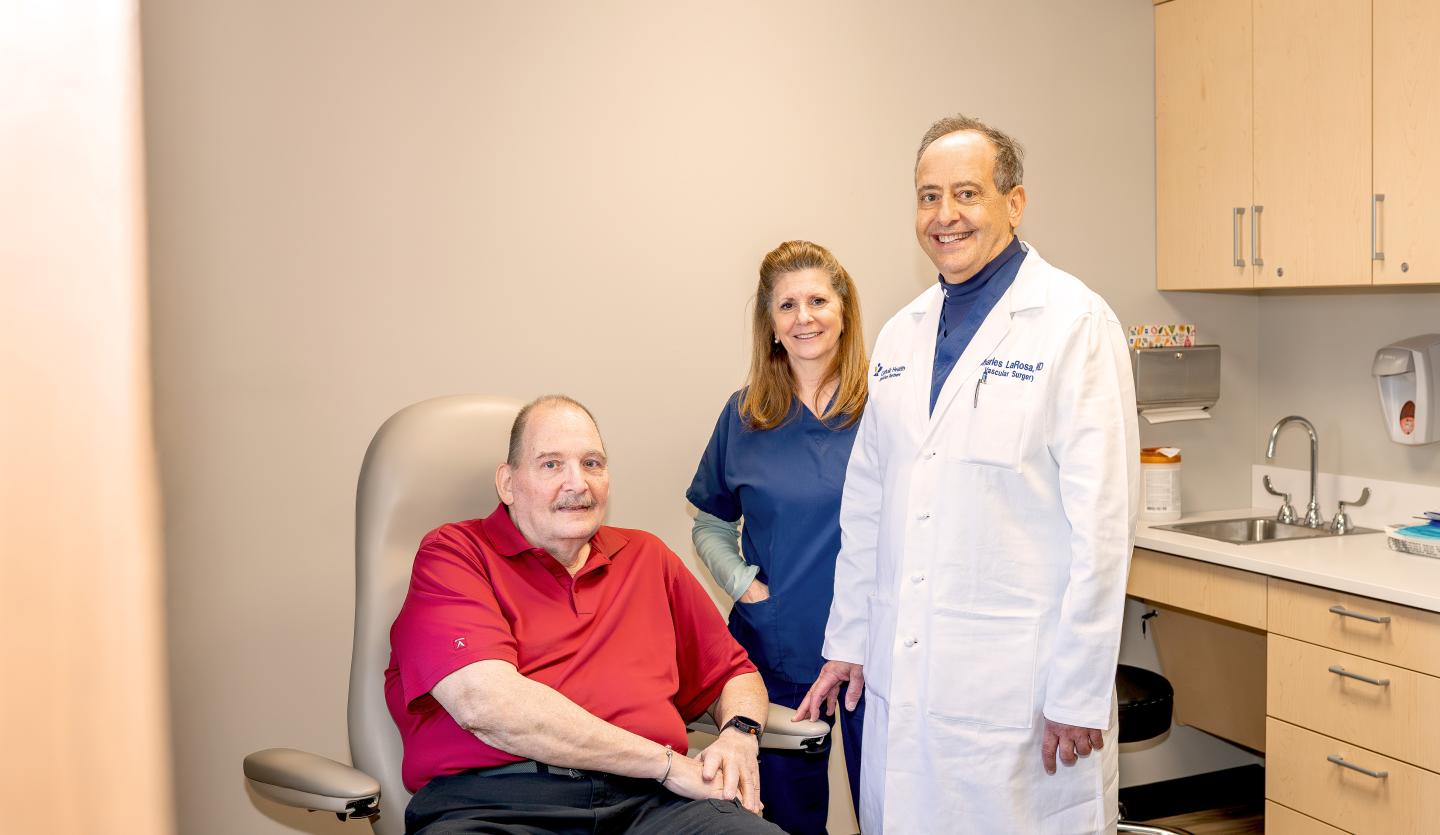
“I didn’t think I’d be able to do any of the things I enjoy again,” Robert Schnepf recalled.
What started as an ulcer on his foot during COVID turned into a five-year battle with a wound that wouldn’t heal due to complications from diabetes. This is often a result of sensory nerve damage and a slower natural healing rate. “Because of neuropathy, I couldn’t feel it,” Robert explained. By the time he realized something was wrong, the wound was beyond standard at-home treatments, and he knew medical intervention was necessary.
During that long stretch of time, the West Islip resident sought help from his podiatrist, and though sometimes progress was made, the wound would eventually open again in a repeating cycle. Once the podiatrist realized the severity was beyond his scope, he referred Robert to the Good Samaritan University Hospital Wound Care Center for specialized care and advanced modalities.
When Robert arrived for his consultation, however, the providers at the center found he was approaching sepsis. “Robert presented with a serious story that is unfortunately too common,” said Dr. Charles LaRosa, Medical Director at the center. “He came to us with Charcot arthropathy with a subsequent ulceration, and we were concerned by its depth and the potential involvement of the underlying bone.” Additionally, the threat of amputation weighed heavily on the medical team.
“That was extremely concerning,” Robert admitted, “because through this whole process my goal had been to return to golf.”
Robert was admitted to the hospital on May 2, 2025, where the medical team was able to stabilize the infection. And after two months of aggressive treatment at the wound care center, Robert was discharged from care on the afternoon of July 4, 2025 – just in time to celebrate the holiday.
During those two months, Robert committed to a rigorous daily treatment plan that included frequent debridements of the wound, culturing of the bone, prolonged intravenous antibiotics four times a day, VAC-assisted closure as well as a TheraSkin skin substitute. This provided him with a plethora of growth factors that would stimulate his wound to fill in and close on its own. “The five-year survival rate for a below-knee amputation is worse than that of having colon cancer,” Dr. LaRosa warned. “So, it speaks to how it physiologically alters the patient and makes their ability to go on with their life and survive very difficult. At the wound care center, we’re very committed to limb salvage. We feel we need to do everything possible to get those wounds healed and help the patient move on with their life.”
And though the schedule could be cumbersome, the wound care center staff always made it a pleasant experience. “It was like coming to see friends every day,” Robert smiled. “We’d talk and laugh, and they’d take care of what I needed. And even though he’s very busy, Dr. LaRosa always took the time to sit and talk and see how things were going for me.”
“We’re very astute to potential comorbidities that might affect the patient’s ability to heal the wound,” said Dr. LaRosa. “It’s important for a successful wound center to not just treat the hole in the patient, but the whole patient. There’s a lot of things to consider when you have a patient who presents with a chronic wound to make sure that every detail is appropriately addressed and considered. And that’s the best way to get a good outcome.”
It's been nearly a year since his treatments have ended and Robert, now sixty-eight, still enjoys a wound-free life. He’s since returned to golf and his regular activities, crediting the education, care and support he received at the wound care center with his continued health success. “They’re great people,” Robert assured, “and they know what they’re doing there.”

 Edge
Edge Chrome
 Safari
 Firefox