

 Find a Doctor
 Find a Location
 Programs & Services
 Appointments & Video Visits
Falls can be a significant concern for older adults. Depending on the severity, a fall can be a dangerous or even life-threatening event.
Falls are the leading cause of injury deaths, hospitalizations and emergency department visits among older adults (adults over the age of 65). Falls can result in long-term, serious consequences, and affect mobility, independence and mental health.
According to the New York State Department of Health (NYSDOH), every day two older adults die from a fall. 140 older adults are hospitalized after a fall, and 223 are treated in the emergency department. About 60 percent of older adults don't go home after a fall. Instead, they're usually transferred to a rehabilitation center or a nursing home. That compromises their independence and, of course, their confidence.
The good news is that most falls can be prevented once you identify and modify your risk factors. Through awareness, practical lifestyle adjustments, and fall prevention programs, the number of falls among older adults can be substantially reduced.
What Increases the Risk of Falling?
The NYSDOH explains that there are several factors that can increase the risk of falls in older adults. These include:
- Leg weakness
- Problems with gait and balance
- Vision impairment
- Chronic conditions including Parkinson's disease, arthritis, osteoporosis and incontinence
- Previous stroke or current heart conditions
- Taking four or more medications simultaneously on a daily basis
A fear of falling can also lead to loss of confidence in older adults resulting in the avoidance of physical activity, increased functional decline, and ultimately an increased risk of falling
Identify and Modify the Risks of Falling
Falls can happen under any circumstances and in many settings. Most falls tend to occur at home and on dry level surfaces - in places and circumstances you would never consider high risk areas. Falls are more likely to occur in living areas, garages, outdoor spaces and bedrooms. The most severe fall-related injuries occur in bathrooms, kitchens and any area with stairs and steps.

“Learning how to prevent a fall is especially important for people over the age of 65. Along with awareness, fall prevention programs help people to learn and recognize fall risks and stop falls before they happen.”
Stacey Pinto, MPH, CHES, Trauma Injury Prevention and Outreach Coordinator at Good Samaritan Hospital
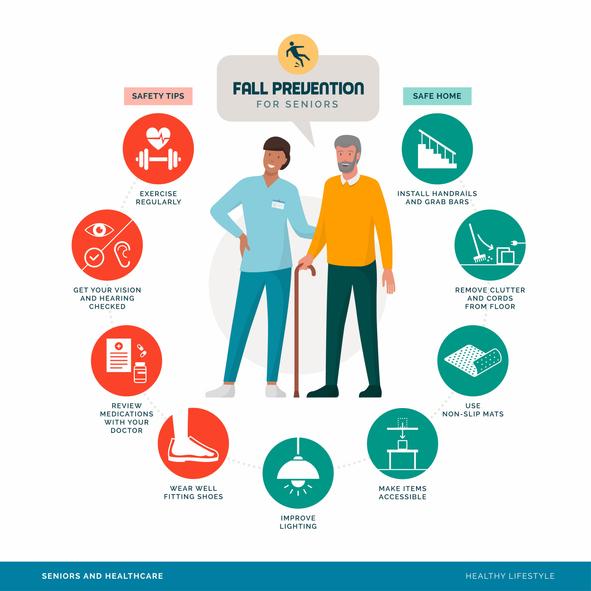
The following tips can help reduce your risk and help prevent fall-related injuries.
Tip 1: Schedule Annual Checkups
Staying up to date with your medical appointments can be an important step in reducing your risks for falling.
- Visit your health care provider for your annual checkup and discuss any fall risk factors or concerns you may have.
- See a specialist for a vision exam at least once a year. Vision problems are a major contributor to falls.
- Talk to your health care provider and pharmacist to ensure the medications you are taking are safe and appropriate. Make sure you are taking the right doses and there are no possible interactions that may increase your risks of falling, especially if you are taking multiple medications.
Tip 2: Stay Aware
- Be aware of your surroundings and address any fall risk factors. Make sure you have proper lighting, particularly on any steps or stairs. Pay attention to your hallways.
- If you get up in the middle of the night, turn on the light. A sensor light that goes on automatically can brighten dark areas, especially in the middle of the night if you are getting up to use the bathroom.
Tip 3: Avoid Clutter
- Make sure there's no clutter on walkways or stairs.
- Don’t keep shoes or slippers by your bed. When you’re getting up in the middle of the night, it’s easy to trip over your shoes and fall.
- Clean up pet toys and pet-related objects from floors.
Tip 4: Inspect Your Floors and Railings
- Remove throw rugs - Rugs can create a big fall risk because they might have curled corners, which can be a tripping hazard. If a rug is not secured to the floor and moves around, it may cause a slip or fall.
- Slippery or inconsistent flooring surfaces can cause people to trip or fall.
- All stairs (inside and outside the home) should have secure railings.
- If necessary, grab bars should be installed in showers and above bathtubs for additional support.
Tip 5: Assess Your Activity
Review your physical activity level and any limitations you have. Talk to your health care provider if you have any mobility challenges to determine if you would benefit from special equipment or a supportive device such as a walker or a cane.
Fall Prevention Programs at Catholic Health
Catholic Health offers three evidence-based fall prevention programs. Evidence-based programs are supported by the most current research on effective fall intervention and are proven to reduce the risk of falling. Programs are open to the community and available free of charge. Pre-registration is required.
Offered at Good Samaritan University Hospital:
A Matter of Balance
A Matter of Balance is an eight-week class that meets two hours a week. It focuses on reducing the fear of falling. Participants are involved in exercises and group discussions. They learn ways to reduce the fear of falling, increase their activity levels, and improve their lower-extremity strength.
Moving for Balance
Moving for Balance is a physical activity class that focuses on slow, flowing movements, breathing, and focused attention. Through a low-impact form of exercise, participants will learn a sequence of movements to improve physical condition, muscle strength, coordination, flexibility, and balance. It is shown to decrease the risk of falling.
Offered at Good Samaritan University Hospital and St. Francis Hospital/DeMatteis Center for Cardiac Research and Education:
Stepping On
Stepping On is a fall prevention program proven to reduce the risk of falls by up to 50 percent. This is a seven-week class that meets for two hours each week.
Participants learn balance and strength exercises, strategies for avoiding falls, and suggestions for home safety checks. Guest speakers discuss the fall risk factors identified in class and different ways to prevent falls. After completing this class, participants feel stronger and more confident going about their daily lives.
To learn more about these programs and enroll in a fall prevention class:
- Good Samaritan University Hospital: Call 516-241-0906
- St. Francis Hospital/DeMatteis Center: Call 516-629-2013
Always contact your physician before starting any exercise program.

Stacey Pinto, MPH, CHES

 Edge
Edge Chrome
 Safari
 Firefox