

 Find a Doctor
 Find a Location
 Programs & Services
 Appointments & Video Visits
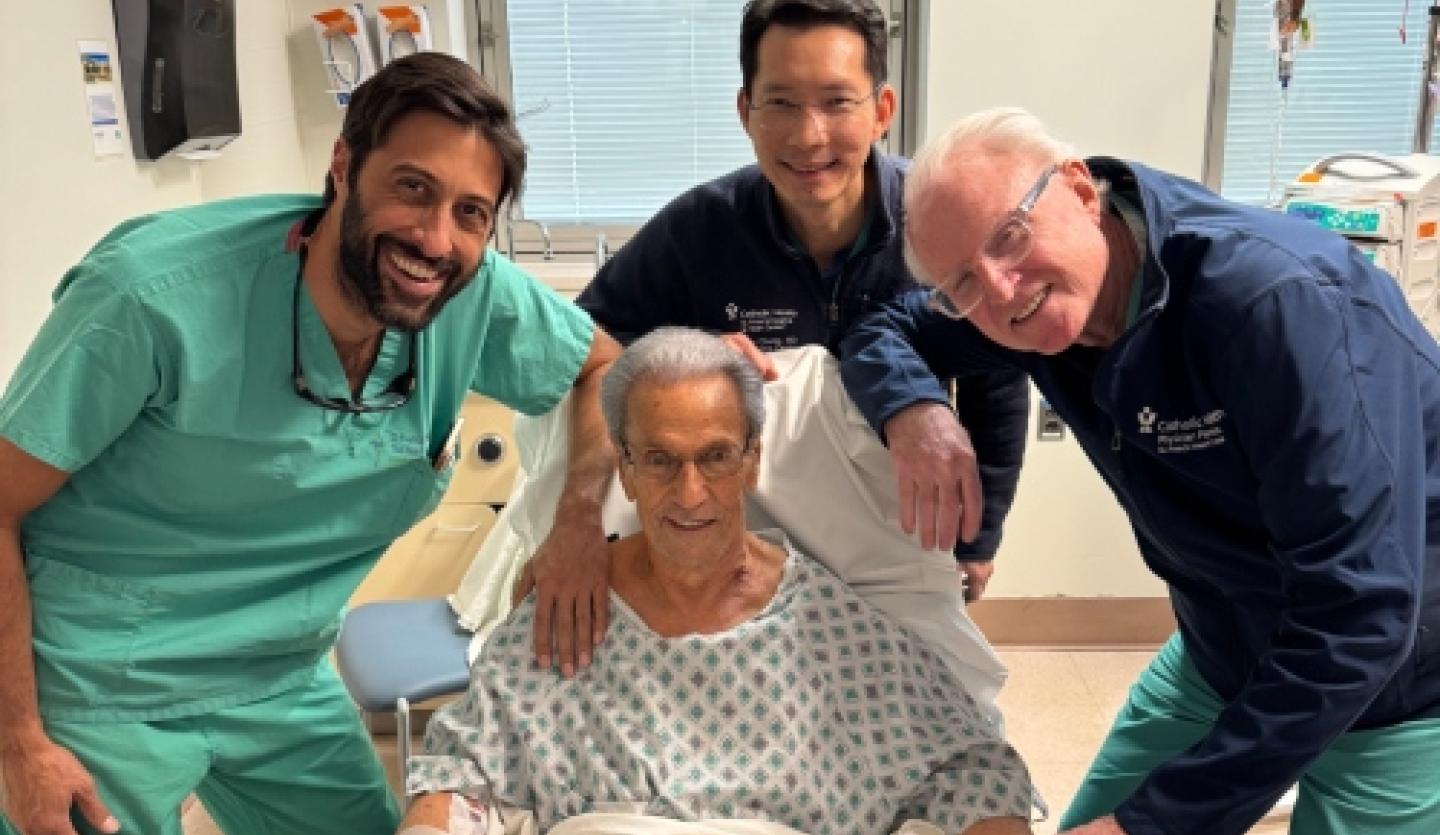
Physicians at St. Francis Hospital & Heart Center have performed a first-in-human investigational heart procedure as part of an FDA-approved Early Feasibility Study (EFS), marking a major milestone in cardiovascular research and innovation.
The procedure is part of the TRAIPTA study, a collaboration with the National Heart, Lung, and Blood Institute (NHLBI) and Cook Medical, exploring a new catheter-based approach to reducing the size of the heart’s tricuspid valve opening, a concept long used in open-heart surgery now being studied in a minimally invasive, catheter-based form.
The procedure was performed by Dr. Jaffar Khan, Dr. Will Chung and Dr. Newell Robinson of St. Francis Hospital & Heart Center, in collaboration with Dr. Robert Lederman of the National Institutes of Health and Dr. Toby Rogers of MedStar Washington Hospital Center, who helped develop the investigational approach.
Advanced cardiac imaging guidance was utilized to facilitate the implant, led by Dr. Omar Khalique, director of the division of cardiovascular imaging.
“Being able to perform a first-in-human study in the U.S. under the FDA’s Early Feasibility pathway is a testament to the experience, infrastructure and commitment to research at St. Francis,” said Dr. Jaffar Khan, director of cardiovascular innovation services at St. Francis Hospital & Heart Center.
The patient, 85-year-old Louis Papa, of Mount Sinai, has Tricuspid Valve Regurgitation, a type of heart disease in which the valve between the two right heart chambers does not function properly, allowing blood to flow backwards. This increases strain on the heart when pumping blood and hinders blood flow to the lungs. This debilitating condition—affecting more than one million people in the United States—can lead to numerous health complications, including fatigue, swelling and irregular heartbeat.
Guided by his longtime cardiologist, Dr. Richard Shlofmitz, chairman of cardiology, St. Francis Hospital & Heart Center, Papa knew he had to address new health issues.
“I was lightheaded after lifting an object, and I felt fatigued after my daily walk,” said Papa. “I called my cardiologist at St. Francis, Dr. Will Chung, and he and the team developed a plan for my care.”
The procedure was performed in December 2025, and Papa is on the road to recovery.
“I realize the risks involved in being the first patient to receive this procedure,” he said. “I knew that my participation in this study would help future patients. And now, I feel great! My energy is back, and I can’t wait to go to Florida with my family!”
The device, manufactured by Cook Advanced Technologies for investigational use only, and procedure are being studied to evaluate whether the approach can be performed as intended. The study is not designed to demonstrate long-term safety or effectiveness.
“It is a real privilege to have the pioneers from the NIH collaborate with our outstanding team at St. Francis Hospital to help bring this procedure to patients,” said Dr. Khan. “This reinforces our role as a global leader in cardiovascular innovation.”

 Edge
Edge Chrome
 Safari
 Firefox