
 Find a Doctor
 Find a Location
 Programs & Services
 Appointments & Video Visits
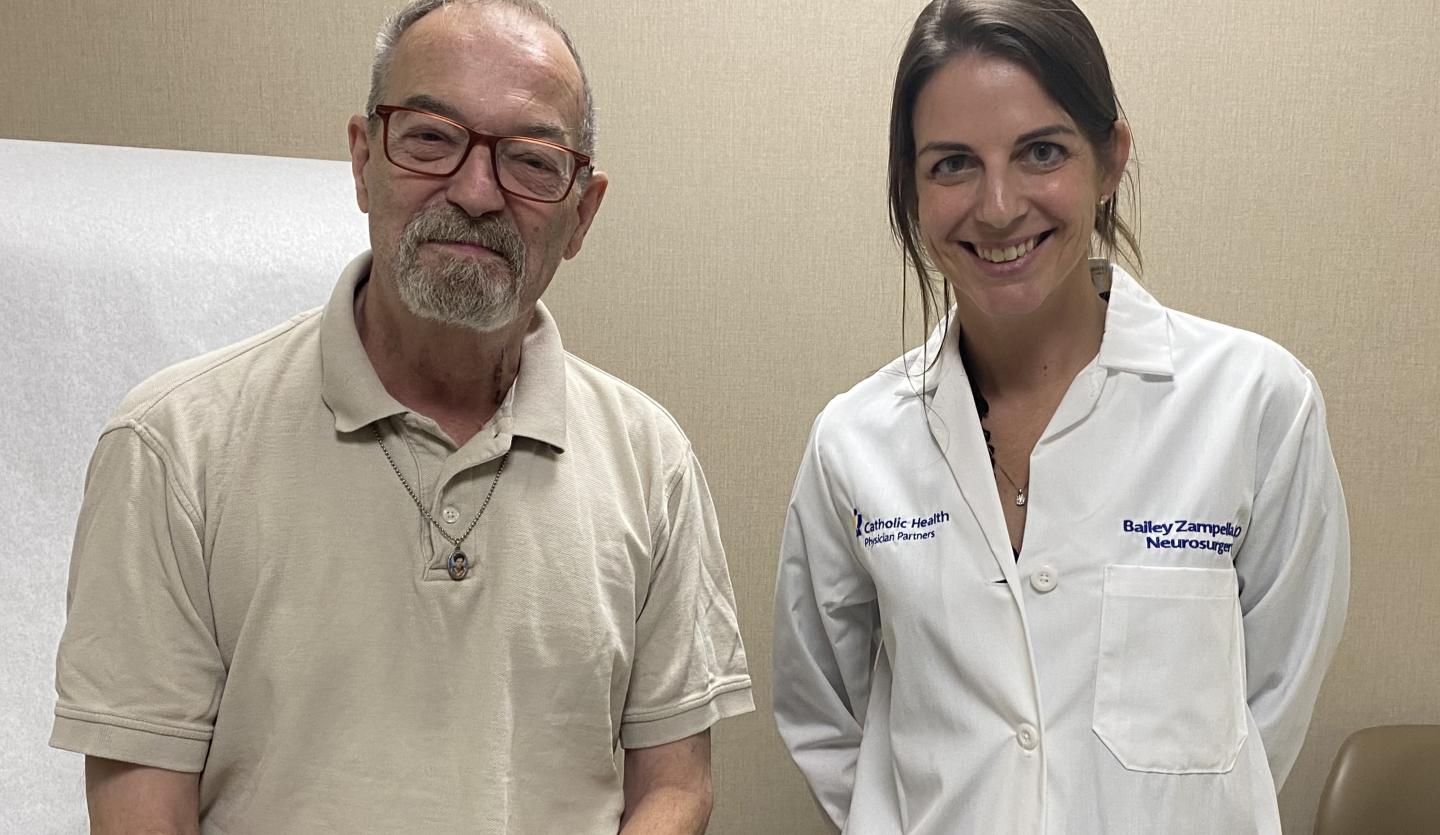
Paul Baker, a three-time stroke survivor from Patchogue, is the first patient at Catholic Health’s St. Charles Hospital to receive MicroTransponder’s Vivistim® Paired VNS™ System, an innovative neurostimulation device that helps stroke survivors regain movement and strength in their arms and hands. The implant procedure was performed by St. Charles Hospital neurosurgeon Bailey Zampella, DO.
The Vivistim® Paired VNS™ System is an FDA-approved, breakthrough technology that employs vagus nerve stimulation (VNS) during rehabilitation therapy to enhance neuroplasticity, helping generate two to three times more hand and arm function for ischemic stroke survivors than rehabilitation therapy alone.
After enduring three strokes that left him struggling to use his left arm and hand, Mr. Baker refused to give up. After meeting with the expert neurosurgical care team at St. Charles Hospital, he opted to receive the Vivistim® Paired VNS™ System. Just two months after the surgical procedure, he’s regaining mobility and reclaiming his independence. Through six weeks of dedicated rehabilitation at Catholic Health Physical Therapy and Rehabilitation in Patchogue, Mr. Baker has made remarkable progress, restoring not only movement, but also hope for a more active, independent life.
“After meeting Mr. Baker and learning how multiple strokes had affected his daily life, I felt that implantation of the Vivistim® vagus nerve stimulator would be an excellent option to help him regain function and improve his quality of life,” said Dr. Zampella. “It’s rewarding to be part of a therapy that empowers stroke survivors to restore movement and reclaim their independence.”
To initiate Paired VNS Therapy, a neurosurgeon implants the small Vivistim® device beneath the skin in the upper left chest during a brief procedure. During subsequent rehabilitation sessions, a physical or occupational therapist uses a wireless transmitter and proprietary software to signal the Vivistim® device to deliver gentle pulses to the vagus nerve as the stroke survivor performs individualized, goal-oriented tasks such as hair brushing, buttoning a shirt or cutting food. Rehabilitation exercises paired with simultaneous vagus nerve stimulation triggers the release of neuromodulators, creating new neural connections and helping the brain relearn skills lost from the stroke.
“St. Charles Hospital is dedicated to advancing recovery for stroke survivors through innovative technology and compassionate care,” said James O’Connor, president of St. Charles Hospital. “As a designated stroke center and the only hospital on Long Island with CARF accreditation for inpatient and outpatient rehabilitation, St. Charles’ dedicated stroke team is able to assist patients affected by stroke. Our goal is to help patients regain their sense of independence, and we are delighted that Mr. Baker is well on his way to achieving that.”
For more information about the procedure or to see if you are a candidate, call (934) 223-7146.

 Edge
Edge Chrome
 Safari
 Firefox