

 Find a Doctor
 Find a Location
 Programs & Services
 Appointments & Video Visits

Ministry Education
In keeping with the mission of Jesus, the Clinical Pastoral Education (CPE) program provides excellence in professional ministry education, preparing persons of all faiths to provide compassionate and respectful spiritual care to all patients and families.
About Our CPE Program
Clinical Pastoral Education (CPE) combines professional education and supervised ministry. It is this combined focus that helps maximize insight and growth from this experiential learning.
CPE uses an adult learning model of education wherein students set their own goals and contract for learning. It is in this setting that students reflect on and learn from their own experiences by seeking feedback from peers and educators. This type of learning aids students in developing self-awareness, both as persons and as pastoral ministers.
The patient or client to whom the chaplains minister is often referred to as “the living human document.” Each student is encouraged to develop various ways of ministering from these “documents.” Interactions with peers and educator, in this learning context, provide helpful critique for the student.
The CPE environment challenges the student to reach out in new ways and to take risks in an educational environment that is safe and conducive to learning and growing in pastoral identity.
- CPE develops skills for pastoral care for people in parish work, chaplaincy, lay ecclesial, ministry, teaching, counseling and other forms of ministry.
- Many theological schools require CPE as part of their field education practicum, contextual education or supervised ministry internship.
- CPE develops skills for pastoral care for people in parish work, chaplaincy, lay ecclesial, ministry, teaching, counseling and other forms of ministry.
- Many theological schools require CPE as part of their field education practicum, contextual education or supervised ministry internship.
- Learning contract negotiated with educator
- At least 400 hours of combined ministry and participation in supervised group process under the direction of an Association for Clinical Pastoral Education (ACPE) certified educator in an ACPE–accredited center
- Recording and evaluation of ministry
- Reflection on ministry with peers and educator
- Individual education conferences
- Final written self-evaluation
- Final written evaluation by educator
- Final goodbye session
- Attendance at graduation
- Demonstrate a solid range of pastoral skills, including listening, empathic reflection, conflict resolution, crisis management and the appropriate use of religious and spiritual resources.
- Competence in providing pastoral ministry to a diversity of persons, with respect to the operative cultural and ethnic needs, social condition, systems and justice issues.
- Provide accurate and goal-oriented spiritual assessments, integrating theology and behavioral sciences.
- Demonstrate a high level of accountability, productivity, self-direction and clear, accurate clinical communication.
- Demonstrate competent use of self in ministry and leadership functions, including emotional availability, appropriate self-disclosure, clear and responsible boundaries and a peaceful, non-judgmental presence.
- Stand as a professional among professionals, establishing collaborative relationships with medical personnel and authorities.
- To be capable of self-supervising through the realistic assessment of one's pastoral functioning.

Fr. John (Jack) T. Crabb, SJ, BCC-E, ACPE/NACC Certified Educator
Fr. Jack came to Catholic Health in June 2020 as the Clinical Pastoral Educator after seven plus years as the Manager of Spiritual Care and Director of Clinical Pastoral Education at The University of Vermont Medical Center in Burlington, Vermont. In 2021 he became Director of Clinical Pastoral Education at Catholic Health.
He was born in Bangor, Maine and lived in South Portland, Maine for many years before going to Boston College. There he received an AB in Classics. After graduating he entered the New England Province of the Society of Jesus (Jesuits). In his early years as a Jesuit he taught at Bishop Connolly High School in Fall River, MA. He did his theology studies at Jesuit School of Theology in Chicago and returned to Connolly High as an administrative assistant to the principal. He was ordained a Roman Catholic priest in the Jesuit Order and has taken Final Vows. He received his Master’s in Administration and Supervision from Fordham and became the first Academic Assistant Principal at Strake Jesuit College Preparatory School in Houston Texas.
Returning to New England, Fr. Jack was the Director of Admissions at Fairfield College Preparatory School (Fairfield CT) for thirteen years prior to becoming the Resident Chaplain at Holy Family Hospital in Methuen MA for five years. There he began his CPE educator training after completing the units for chaplain certification. Fr. Jack was certified as a chaplain with National Association of Catholic Chaplains (NACC) in 1997. He has served as the administrator and treasurer of Eastern Point Retreat House in Gloucester MA for four years. For a portion of that time and beyond he was doing CPE supervision at Beverly Hospital in Beverly MA (8 years).
Fr. Jack was the founding director of the CPE Program at Mercy Hospital in Portland Maine. In 2003 Jack was certified a CPE Educator by NACC and in 2010 a CPE Educator by ACPE. Fr. Jack has a love for parish ministry as he has done weekend supply for a number of years in local parishes, having stayed with two different parishes for a total of six years. He currently assists at St. Anthony’s Parish in Oceanside NY. Fr. Jack brings solid knowledge of the chaplain certification process as for six years he was a member of the NACC Certification Commission, the last three as Chair of the Certification Commission. He then served a full six-year term as an elected member on the NACC Board of Directors.
In 2021 Fr. Jack received the Distinguished Service Award from NACC. In the former Northeast Region ACPE Fr. Jack served as the region’s Secretary and was a member of the Accreditation Committee. He currently is the co-facilitator of the Catholic Educators ACPE Community of Practice. He has contributed his skills for detail and organization by being the editor of the CPE Fair Booklet that each year is given out to seminarians and others in New England.
Fr. Jack maintains an open door policy and encourages students to contact him whenever they have concerns. His mantra is “open, honest, direct, immediate and imperfect.” He especially likes the quote from Ralph Waldo Emerson that states “What lies behind us and what lies before us are tiny matters compared to what lies within us.” His overarching philosophy is the Ignatian principle to take an individual where that person is and to see God’s grace and giftedness within the person.
Certification as a chaplain requires 4 units of CPE, a Masters Degree in Theological Studies or in some cases an M.Div. and meeting with one of the National Committees: The National Association of Catholic Chaplains; The Association of Professional Chaplains; or Neshama: Association of Jewish Chaplains.
Summer CPE
For persons needing an intensive full-time program that falls outside the typical academic calendar from the middle of May until early August. Although this program usually has seminarians, other interested persons are strongly encouraged to apply. The group meets for educational instruction on Tuesday and Wednesday. Monday, Thursday, and Friday are clinical days in the hospital. All inquiries should be sent to the Director of Clinical Pastoral Education at Catholic Health.
- 2025 Summer May 20, 2025 to July 30, 2025
- 2026 Summer May 19, 2026 to July 30, 2026
- 2027 Summer May 18, 2027 to July 29, 2027
Extended CPE
For persons able to make a part-time commitment. The extended CPE unit begins in mid-October and ends in mid-April. The CPE program meets one day a week in groups and runs for about 24 weeks. The program requires an average of 16 hours a week between group time, individual supervision and clinical work with patients. All inquiries should be sent to the Director of Clinical Pastoral Education at Catholic Health.
- 2025 Extended November 13, 2025 to March 26, 2026
- 2026 Extended October 8, 2026 to February 25, 2027
- 2027 Extended October 7, 2027 to February 24, 2028
Residency CPE
Individuals who have completed at least one full unit of CPE from an accredited CPE center are candidates for a year-long paid residency program. The residency program offers three CPE units over the academic year. This program requires residents to do 37.5 hours a week, which includes class time. The group meets for educational instruction on Monday and Tuesday. Wednesday, Thursday, and Friday are clinical days at the placement site. Residents are eligible for benefits of vacation, sick time and have breaks scheduled in between each unit. All inquiries should be sent to the Director of Clinical Pastoral Education at Catholic Health.
- 2025 Residency September 8, 2025 to May 15, 2026
- 2026 Residency September 8, 2026 to August 26, 2027
- 2027 Residency September 7, 2027 to August 31, 2028
Listing of Assigned Placements
Each CPE participant will have the opportunity to practice providing spiritual care. It is expected that the CPE intern will initiate spiritual care visits, respond to referrals from the health care team and collaborate with staff chaplains in the assigned areas. The CPE intern will be encouraged to work closely with the health care team to foster the practice of interdisciplinary dialogue and collaboration. Various clinical assignments are available through the various Catholic Health facilities, including six acute care hospitals, three nursing homes, a home nursing service and hospice care.
Additional CPE Program Information
- Completed application
- Admission interview
- Basic college degree (BA or BS)
- Adequate background in theology to participate in theological reflection
- Ability to reflect on ministry and learn from experiences
- Ability to participate in an adult learning model
- Ability to successfully pass a background check and health screening as required by Employee Health
Catholic Health's CPE has seen seminarians, ordained ministers and priests, lay men and women, religious sisters and brothers, nurses and social workers enrolled in our program. Many faiths have been represented. Some will enroll in CPE as a requirement from their ordination body. Others desire to follow a career as a chaplain. Still others sign up for CPE for a personal growth experience or to discern a ministry direction.
There is a $25 application fee that should accompany the application or sent separately if application is sent by email. Make check payable to Catholic Health and note that it is the application fee. Send check to Fr. Jack Crabb at the address as shown on the application form. We do not have credit card or electronic access available. Cash is acceptable
Please download and print the application and reference forms below to be considered for the Clinical Pastoral Education (CPE) program of Catholic Health. Send the reference form directly to those who know you. Inform them to send the form directly to Fr. Jack Crabb, SJ, Director of Clinical Pastoral Education.
Mail your completed application to Fr. Jack Crabb.
Contact Information:
Clinical Pastoral Education
Attn.: Fr. John T. Crabb, SJ
Catholic Health
992 North Village Avenue, Rockville Center NY 11570
john.crabb@chsli.org
631-465-6276
We will schedule an interview when your application is complete.
Tuition is $950 per unit, the balance payable during the first week of the program unless otherwise arranged with the educator. A non-refundable deposit of $250 is required at the time of acceptance and is credited toward tuition cost.
Catholic Health's CPE program uses a rolling admissions format. As such there are no set deadlines. We fill the openings based on qualified applicants in the time in which they apply. We do maintain a wait list should an accepted student decide to withdraw before the beginning of the session. Normally students would not be accepted within the last month prior to the beginning of a session. Employee Health and background check must be completed before interns will be able to visit patients.
Essential Components of the Catholic Health CPE Curriculum
The goals of the Catholic Health CPE program are to assist student learning in the area of personal awareness and self-discovery so that pastoral care is enhanced by knowledge of one's strengths and weaknesses as he/she participates in ministry. The seminars are intended to address the following areas.
- Review pastoral care work
- Focus upon theological reflections, growth and challenge
- Focus on interpersonal relationships and issues
- Focus upon building care giving and pastoral skills.
- Foster pastoral and professional identity growth
During a seminar, reports of visits are presented, worship services are reviewed for feedback and discussion, and theological reflection is shared. Meetings of the peer group are a valuable resource to students. These groups are defined by the covenant that develops over time between peers. The agenda for peer groups is the development of professional accountability, pastoral identity, and pastoral authority.
At the beginning of each CPE unit, the students identify goals and develop a statement of a) personal, b) professional, and c) theological goals to be addressed during the unit. These goals become the basis of the learning contract/covenant that is established between the student, the educator and the peer group. In our philosophy of education it is understood that adults are responsible for their learning based on the learning covenant. Students design a group covenant to express their commitment to the group and what each could expect from the other members.
In designing a curriculum of clinical pastoral education, the goal is to provide an environment that is safe and challenging, structured and flexible in order to foster creativity and learning in an action / reflection / integration / action learning process. Students learn best when they are able to make choices and when they can contain their anxiety within manageable levels. The basic curriculum rests on the premise that the unique quality of pastoral care is its theological foundation and seeks to utilize theological resources in responding to pastoral care needs. The CPE program focuses on the development of pastoral authority and identity. Repetition is a key educational element to attain ownership of those areas of growth that the student desires to achieve.
In accordance with the adult model of learning, students set their own goals for personal, professional, and theological growth in regards to pastoral ministry. This will be facilitated by the educator according to standards of ACPE.
Goal setting responds to the following: What do you want to learn personally and professionally? How will you learn it? How will you and someone else know you have learned it? The student discusses and revises goals with the educator and the peer group; they are a core element of the learning covenant and establish the relational aspect of the learning experience. The goals are frequently highlighted in educatory sessions and are reviewed and revised at mid-term.
A one-on-one with an individual educator. During this time, learning goals, patient care and personal growth are focused upon.
The essential component of the clinical pastoral education experience is the actual ministry with people. Students are assigned as chaplains to placements within Catholic Health where they have responsibility to provide pastoral care with patients, families, and staff. The experience of being a chaplain gives them the chance to learn by action, to have the experience to reflect on and to try new pastoral responses. The client/patient is the “living human document” and provides the encounters that are formative for the student. The student participates in choosing his/her placement for ministry and spends 15 (extended) or 20 (summer) hours weekly in that ministry.
The student is a member of a group of at least three and not more than seven peers. At least one hundred hours of the required 400 hours total are spent with the group and/or educator in reflecting on ministry and topics relevant to ministry. The peer group participates in verbatim seminars, pastoral consultation, Interpersonal Relationships Seminar (IPR), didactics, reading discussions and educatory conferences. Sessions included in the curriculum rest on the needs of the group.
One of the elements that distinguishes the Catholic Health CPE summer unit is the role play seminar held the first day back from the weekend immediately after staff check-in. Placing the role-play at the beginning of the week gets the student reinvigorated and reconnected to the program after having been away from group for the weekend. The role-play seminar provides an opportunity to experiment and practice ways that the intern would handle similar situations in their eventual full-time ministry placement.
These seminars review clinical work utilizing pastoral call reports and verbatims to analyze the dynamics of a visit. They focus on learning pastoral care by direct experience and the reflection of the group's experience and insight. Many students are surprised to learn that verbatim seminars are not really about the patient but rather about the student. There are important reasons for this. Ministry happens out of who we are as persons - our beliefs, our feelings, our fears, our strengths, and our weaknesses. CPE is designed to help participants learn about themselves in ministry so they might minister with more self awareness, deeper understanding of human nature, a more complete picture of God and an appropriate set of boundaries. Understanding how to minister to people in crisis is only a fraction of what a student learns.
IPR seminar is a time when peers gather as a group with no prepared content or agenda. This time allows students a forum within which to explore personal issues, interpersonal communications and group process and dynamics. They may offer feedback to others. They may receive feedback unsolicited from others. They learn to address issues in relationships and to deal with conflict. It is a time of learning communication skills that can support them in clarification, support and challenging themselves and others. This may be seen as a lab for trying new behaviors one may have avoided heretofore. Part of the group experience is to create an agreement or covenant for the group through which members share a commitment and responsibility for the life of the group. This is where much of the relational learning of CPE comes to focus for the students.
Special speakers and special teaching situations are scheduled throughout the CPE unit to enhance learning in areas of growing interests and ministry challenges. Lectures and seminars are offered to students on topics related to the pastoral care within a hospital setting, to health care, and other medical and pastoral topics. Many are selected in consultation with students or chosen as a result of the expressed needs of the students. One of the key didactics involved a visit to a local funeral home since many of the students were of the age that they had not seen the inside of a funeral home.
Worship involves the peer group gathering together to worship, pray and experience fellowship together. They learn means to design a worship that is interfaith in nature. The responsibility for worship is shared among the students. Each student has responsibility to conduct worship individually and one time with a person from a different faith tradition as a means to develop communication with a person of another tradition and to experience further interfaith worship.
In addition students are encouraged to participate in their placement’s rounds. Within the Hospital and medical community, lectures and seminars are offered and CPE students are welcomed. Interdisciplinary resource persons from other disciplines are available and many have active roles in the Chaplaincy programs and in the CPE unit. Interaction with the staff of the placement to which the students are assigned and encouragement to communicate with the various members of the treatment team - nurses, physicians, social workers, clinical specialists, and other staff- are examples of the involvement of persons from other disciplines. Students are encouraged to attend staff meetings and case interdisciplinary rounds and to avail themselves of educational opportunities, lectures, grand rounds, offered in their clinical setting. There is a wealth of resources from which to draw and staff who are eager to be involved in educating others about their areas of specialty and expertise. As part of the team ministering to the patients the students learn and share from a wide perspective about the concerns and issues surrounding the patient and his/her family.
We encourage students who feel they have completed the Outcomes of Level I or Level II to request an appropriate consultation. Preparation of papers and meeting a committee of professionals to defend various levels of competency, help the student prepare for certification.
At the midpoint and end of a CPE unit, students are evaluated. The midterm evaluation is written by the student and submitted to the educator. At the end of the program, both student and educator write a final evaluation which are companion pieces for future use. In these evaluations, information is presented as objectively and helpfully as possible to encourage the growth accomplished during the unit and the growth that is yet to come. Since these often become documents given to ordination or ministry committees, great care is given to being constructive and honest.
On the last day of the program the students meet as a group and individually with members of the Professional Advisory Group (PAG). This is a time for the students without the educator present to voice their concerns and affirmations of the program and/or educator. The PAG member who chaired the meeting writes up a report that is presented to the Clinical Pastoral Educator This report gives the educator areas to enhance or to reform. The Educator also can see areas that are needed for change or affirmation within the CPE program
Catholic Health Clinical Pastoral Education Program is accredited by the Association for Clinical Pastoral Education Inc. (ACPE).
ACPE is an interfaith association that was founded in 1967. ACPE provides Standards and Objectives for developing CPE programs. The Association certifies CPE educators who have fulfilled requirements for certification. ACPE also accredits centers to offer programs in CPE.
ACPE: The Standard for Spiritual Care and Education
Association for Clinical Pastoral Education
1 Concourse Pkwy
Suite 800
Atlanta, GA 30328
404-320-1472
Fax: 404-320-0849
www.acpe.edu
acpe@acpe.edu
To ensure that this Association for Clinical Pastoral Education (ACPE) CPE center/program guarantees to its students the rights to inspect and review education records, to seek to amend them, to specified control over release of record information, and to file a complaint against the program for alleged violations of these Family Education and Privacy Act (FERPA) rights.
Annual Notice will be published annually on the www.catholichealthli.org web page and in the CPE Student Handbook.
In addition to the information stated above, Catholic Health guarantees to its students the rights to inspect and review education records, to seek to amend them, to specified control over release of record information, and to file a complaint against the program for alleged violations of these Family Education Rights and Privacy Act (FERPA) rights. Students also have the right to object to record content. If not negotiable, the written objection will be kept with and released with the record. Grades are exempted from this right.
Violations of these protocols may be reported to the Chair of the Accreditation Commission at: ACPE, 1 Concourse Pkwy Suite 800 Atlanta GA 30328
Catholic Health Clinical Pastoral Education (CPE) Program Maintenance of Student Records/Annual Notice
I. This ACPE CPE center/program guarantees to its students the rights to inspect and review education records, to seek to amend them, to specified control over release of record information, and to file a complaint against the program for alleged violations of these Family Education and Privacy Act (FERPA)
II. Catholic Health Directory information and how to opt out:
Directory information is student information not generally considered harmful or an invasion of privacy if released. Catholic Health CPE directory information includes name, address, email, telephone, religion, previous education, and photograph. Students may opt out completely from having directory information disclosed. Students may also choose to review and select directory information that is acceptable to the student for release. All other information is released only with the student's written, signed, dated consent specifying which records are being disclosed, to whom, and for what limited purpose.
Before releasing information, students must have received this Annual Notice. Current students can restrict directory information and/or record access at any time during attendance.
Restrictions must be honored even after the student's departure. Former students cannot initiate new restrictions after departure.
Ill. The definition of student records:
A student record is: (1) any record (paper, electronic, video, audio, biometric etc.) directly related to the student from which the student's identity can be recognized; and (2) maintained by the education program/institution or a person acting for the institution.
- Catholic Health record's management
ACPE requires that:
- The center retains the following items indefinitely:
- The application face sheet
- The Use of Clinical Materials Consent Form
- The center retains the following items from the student record for 6 years:
- The Certified Educator's end of unit
- The student's response to the end of unit evaluation, if submitted
- The student's self-
Note: Application face sheets for students who are not accepted into the CPE program are kept indefinitely by the center. The written materials are destroyed per the HIPAA Guidelines of Catholic Health
A student has the right to object to record content. If not negotiable, the written objection will be kept with and released with the record. Grades are exempted from this right.
The ACPE educator will give each student the opportunity to write an addendum to the Educator's evaluation. This addendum is attached to the evaluation and is released with the evaluation when a proper release request has been received.
A copy of the ACPE educator's evaluation report will be given to the student within 21 days of completion of CPE unit. The student will be informed that the center will keep this evaluation for a minimum of six years, and it will not be available to anyone else except with written permission from the student. The student's own evaluation will be kept with the educator's subject to the same provisions.
Time Extension for Educator's Evaluation per ACPE Standards. Educator's evaluation will be available to the student within 21 calendar days of the completion of the unit. To extend this deadline in rare, unusual circumstances, the educator may negotiate with the student and receive approval from the accreditation chair to extend this deadline. The Educator's evaluation will document this process, and such instances will be reported on the next annual report.
- Education Officials and Legitimate Education
Only Educational Officials (ACPE Certified Educator/ACPE Certified Educator Candidate) will have access to student files for educational purposes without student consent. An example of a legitimate educational interest includes an ACPE Educator accessing the application/biographical information of a student who is being supervised at the time by the ACPE Educator. In addition, the System Vice President of Pastoral Care and Formation or delegate, or Mission Department secretary charged with assisting with the custodial care of the CPE student records will have access to the student files without student consent.
- Violations of Annual Notice protocols may be reported to the Chair of the Accreditation Commission at: ACPE , 1 Concourse Parkway, Suite 800 Atlanta, GA 30328 Telephone: (404) 320-1472 Or via email: accreditation
 acpe [dot] edu (accreditation[at]acpe[dot]edu)
Research: If information in student records or in a CPE educator's records is considered of research value, and a CPE center or ACPE desires to collect and use such material for research, a release form shall be made available for the person's signature. No personally identifiable material will be used for research without the person's written permission for its use.
A directory of student information will be provided within the department. Directory information will include your name, address, email, telephone, previous education and photograph. ·All other information is released only with your written, signed, dated consent specifying which records are being disclosed, to whom, and for what limited purpose.
- You have the option to restrict directory information and/or record access at any time. during
- At the completion of each unit, your name, email, denomination and unit of CPE successfully completed will automatically be registered with ACPE upon your acknowledgement of your Educator’s Final Evaluation. Your credit will be based on the Likert scale percentage and will notify whether you may advance to the next level of CPE [1B, 2A, 2B]
"Opt Out" - If you do not wish to share the above directory information, you have the option to "opt out." If you wish to "opt out" your information, please sign and return the. bottom portion of this form to the ACPE Educator.
Student Record Guidelines:
The student record is defined as: Any record (paper, electronic, video, audio, biometric etc.) directly related to the student from which the student's identity can be recognized; and maintained by the education program/institution or a person acting for the institution.
- Application materials of students admitted, matriculated and completing orientation are part of the student record.
- The student record kept at this program will include
- The application face sheet
- The Use of Clinical Materials Consent FormThe Certified Educator's end of unit evaluation
- The student's response to the end of unit evaluation, if submitted
- The student's self-evaluation.
- CPE students are expected to give written consent for copies of the educator's evaluation reports and their own to be sent to their theological school and/or to formation personnel ( e.g. Director of Seminarians of Diocese).
- A copy of the CPE educator's evaluation report will be given to the student and· will not be available to anyone else except with written permission from the
- Health records (mental and physical) will be kept in locked, limited access files, separate from other student records. Their use and release is subject to ADA and HIPAA. Certain safety and employment records are also subject to other federal regulations and state laws, and are kept separately. Rarely are any of these items provided to the CPE Educator. Regularly they are kept with Catholic Health’s Employee Health personnel in locked files.
- Material written by students, such as verbatims and case histories that contain information about other persons, including other students, will either be destroyed at the end of the unit or, if they are part of the student’s record, will have the identifiable information about everyone other than the student redacted. When peers are referenced in student’s evaluations, only initials must be used.
- Students are responsible for maintaining their own files for future use. This center will not keep a permanent file or evaluation Student records will be kept at this center for six (6) years. After six (6) years, this center will only keep the student's face sheet.
- In the circumstance that this center had to close, the administrator to whom the CPE Certified Educator reported would be responsible for maintaining the student files under lock. The area accreditation commissioner liaison would be a resource for verification of ACPE policy at the time of closure should the CPE Educator not be available. The designated administrator will be responsible for culling the records and keeping the ACPE required material in accordance with the six (6) year ACPE policy of retaining student file material. The Accreditation Commission Chair and the ACPE office will be informed of the records'
- Students have approval to review their record within 45 days of a written request. Record inspection cannot be denied based on the student’s inability to come to the site or outstanding financial obligations. In the latter case, Catholic Health CPE program can note on the copy sent, “not available for official use.” When a student record contains identifiers of another student, those must be redacted. Students may copy their records with Educator or designee present provided they are in good standing. Good standing means that all obligations for completion of the unit have been met. Likewise good standing during a unit means that the student has fulfilled all written work, paid full tuition or has arranged for a payment plan.
- Catholic Health does not maintain digital or electronic records. All records are paper generated.
A student has the right to object to record content. If not negotiable, the written objection will be kept with and released with the record. Grades are exempt from this right.
Records Management:
- Student records will he kept in a locked filing cabinet within the department and will be accessible to those deemed as "educational officials" at this program. These individuals may have access to student records without student consent for*"legitimate education " This includes the following people:
- Clinical Pastoral Education Director
- CPE Educator(s) / Certified Educator Candidate(s)
- Members of Professional Advisory Group
- Secretary of the Pastoral Care Department/CPE has access to student records for record management purposes.
In front of every student folder will be a sheet of paper with the following message:
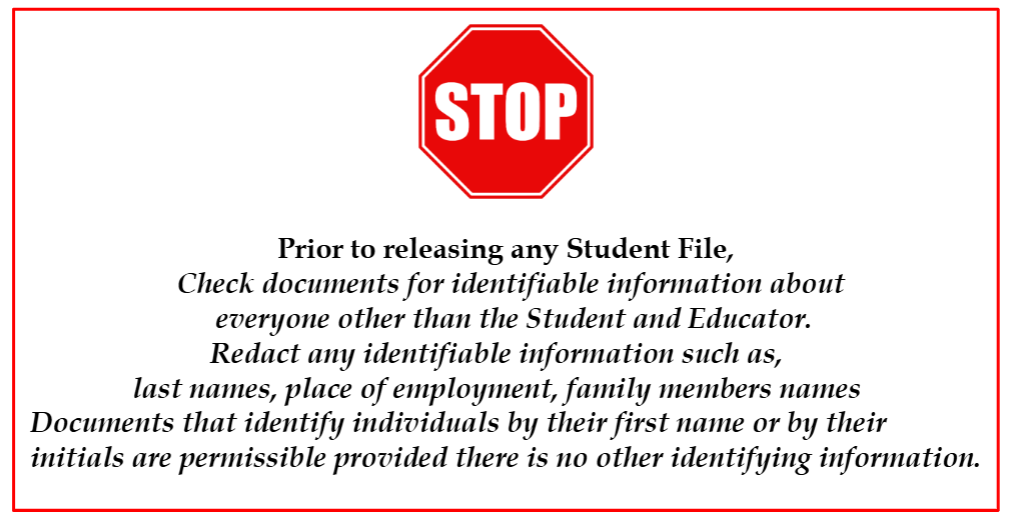
Certain exceptions concerning the release of information exist to protect the health or safety of the student or others, and/or the purpose of accreditation or complaint review, or as required for legal Before releasing material in any of these circumstances, the ACPE Certified Educator will consult with the Vice President of Pastoral Care and Formation, the Chair of the Professional Advisory Group and or the legal counsel of Catholic Health if necessary.
- Maintenance of Student Records / Annual Notice will be published annually on the CHSLI.org web page and in the CPE Student Handbook. Applicants offered a placement in any program will receive the Maintenance of Student Records/Annual Notice as part of their acceptance packet.
*Note - "legitimate education interests" include accessing student record information for the enhancement of the student's education and for the purpose of writing student evaluation reports.
Violations of these protocols may be reported to the Chair of the Accreditation Commission at: ACPE Inc., 1 Concourse Parkway, Suite 800 Atlanta, GA 30328 Telephone: (404) 320-1472. Or via email: accreditationacpe [dot] edu (accreditation[at]acpe[dot]edu)
Please sign and date the below acknowledgement form and return to the CPE Educator.
Student Acknowledgement of the Annual Notice/ Consent to "Opt Out"
I have received a copy of The Maintenance of Student Records/ Annual Notice, have read, and understand the contents within the document.
I give consent to publish my directory information.
I DO NOT give consent to publish my directory information.
I give consent for LIMITED access to my directory information.
(Please provide in the space below the information you wish included.)
Student Name (print)
Student Signature _______________________Date____________
Students must give written permission to the use of their clinical material as well as recorded and/or live observation media pertinent to the supervisor’s process toward certification as an ACPE Educator by signing Use of Clinical Materials Consent Form. Note: Only the Use of Clinical Materials Consent Form is acceptable for obtaining students’ written permission to use personally identifiable material. Students being accepted into a unit of CPE are to review and sign the Use of Clinical Materials Consent Form prior to formal admission to the CPE program or a unit of CPE Level I/Level II supervised by a Certified Educator Candidate. (See ACPE Certification Manual, General Certification Policies.)
Read below for frequently asked questions about the Clinical Pastoral Education (CPE) Program of Catholic Health and the Diocese of Rockville Centre.
During the Residency and Summer programs, CPE students meet for instructional presentations, discussions of case studies and reflections for two full days each week. Residency and Summer students visit hospital patients the three other days during each week. During the Extended program, students meet for instructional presentations, discussions of case studies and reflections one day a week in the morning and afternoon. Extended students visit hospital patients on days they arrange with the educator based on the flexible nature of the extended program.
Students meet with a CPE educator for about an hour a week in the summer unit and every other week for the extended unit during which they discuss ministry events, personal issues and theological questions.
Each CPE student develops learning goals around pastoral reflection, pastoral formation, pastoral competence or pastoral specializations.
Students are expected to attend all CPE activities. A conference with the educator is required if a student anticipates missing more than two days.
Students have clinical assignments to specific hospital services.
The staff chaplains act in the role of preceptors for CPE students. They help with orientation, shadowing and mentoring.
Yes, if you are enrolled as a student in a seminary or graduate school of theology, and if your school grants credits for supervised practice or field work, you can get between 3 to 6 credits (depending on the school). However, if one is not enrolled as a student in an academic program, one cannot obtain academic credit.
CPE students are protected by the Family Education Rights and Privacy Act (FERPA), which protects the privacy of adult student education records. Click here for more information.
Student CPE evaluations are kept on file for ten years. The evaluations can only be released with the student's written permission.
Catholic Health CPE does not have an overnight on-call requirement.
Be sure to set up an interview either with the Catholic Health Clinical Pastoral Educator or, if out of state and unable to make an interview at Catholic Health, arrange with a certified Association for Clinical Pastoral Education (ACPE) educator in one's home locale. Have that educator conduct the interview and send a written report to the Catholic Health Clinical Pastoral Educator.
We receive many applications. Decisions are made on a rolling admission basis for each CPE unit.
Students can expect to wait several weeks for an answer.
No. Catholic Health's CPE has seen seminarians, ordained ministers and priests, lay men and women, religious sisters and brothers, nurses and social workers enrolled in our program. Some will enroll in CPE as a requirement from their ordination body. Others desire to follow a career as a chaplain. Still others sign up for CPE for a personal growth experience or to discern a ministry direction.
The Association of Professional Chaplains, the National Association of Catholic Chaplains, the Neshama Association of Jewish Chaplains and other organizations certify chaplains. The American Association of Pastoral Counselors trains and certifies pastoral counselors. Some CPE is required as a prerequisite. You should contact these organizations directly about their requirements.

 Edge
Edge Chrome
 Safari
 Firefox