
 Find a Doctor
 Find a Location
 Programs & Services
 Appointments & Video Visits
Some wounds refuse to heal. You keep the area clean, change the dressings and follow every instruction, but weeks go by with little change. For many people, the missing piece is oxygen.
Hyperbaric oxygen therapy gives your body more of the oxygen it needs to repair damaged tissue. It is painless, it is noninvasive and for the right conditions, it can make a real difference.
What Is Hyperbaric Oxygen Therapy?
What is hyperbaric oxygen therapy? It is a treatment where you breathe 100% pure oxygen inside a pressurized chamber. You may also hear it referred to as HBOT or HBO2 therapy.
The air you breathe every day is only about 21% oxygen. Inside a hyperbaric chamber, you breathe pure oxygen at two to three times normal air pressure. That combination lets your blood carry far more oxygen than it can on its own.
“Many patients come to us after months, sometimes years, of struggling with wounds that refuse to heal. They arrive exhausted, frustrated, and often losing hope,” said Aprilee Garlick, Program Director of the Wound Care Center at Mercy Hospital. “ I remind them that this is not the end of the road, but the beginning of renewed hope. We are not just treating wounds; we are restoring confidence, independence, and quality of life. There is nothing more rewarding than watching a wound finally close and seeing hope return to someone's eyes. That is why we do what we do.”
How Hyperbaric Oxygen Therapy Works
Normally, red blood cells carry oxygen through your body. When a wound has poor blood flow, not enough oxygen reaches the tissue to heal it.
Higher pressure changes that. It allows oxygen to dissolve directly into the plasma, the liquid part of your blood. That oxygen-rich plasma can reach tissue that red blood cells have trouble getting to. Over a series of treatments, this extra oxygen helps your body:
- Build new blood vessels — Better blood flow to the wound area supports healing long after treatment ends.
- Fight infection — White blood cells need oxygen to kill bacteria. More oxygen helps them work better.
- Grow new tissue — Cells use oxygen to make collagen and repair skin and bone.
- Reduce swelling — Higher oxygen levels help narrow blood vessels and ease swelling around injured tissue.
Hyperbaric Oxygen Therapy Benefits: Who Can It Help?
Hyperbaric oxygen therapy benefits people whose bodies need extra help to heal. That often includes people with diabetes or poor circulation, cancer survivors who had radiation therapy and people with wounds that have not improved after four weeks of standard care.
Hyperbaric oxygen therapy for wound healing is the most common reason people come to us. HBOT can also treat emergencies such as carbon monoxide poisoning and diving injuries.
HBOT is not right for everyone. Your physician will review your health history first. Certain lung conditions, recent ear surgery, some chemotherapy drugs and pregnancy may affect whether it is safe for you.
Be cautious about wellness centers and spas that promote hyperbaric treatment for conditions like autism, Alzheimer’s disease or cancer. The U.S. Food and Drug Administration (FDA) has warned that these uses are not proven. HBOT works best when a trained physician prescribes it for a condition where research supports it.
Common Medical Uses for HBOT
Physicians prescribe HBOT for specific conditions where research shows clear results. These are the most common:
- Air or gas embolism — Air bubbles in the blood vessels can block blood flow. Pressure shrinks the bubbles so blood can move again.
- Carbon monoxide poisoning — HBOT clears carbon monoxide from the blood much faster than breathing regular oxygen.
- Chronic bone infections — Bone infections that have not responded to antibiotics and surgery can improve with added oxygen.
- Crush injuries — Severe injuries that cut off blood flow to muscle and tissue may heal better with HBOT.
- Decompression sickness — Scuba divers who rise too quickly can develop “the bends.” HBOT is the standard treatment.
- Diabetic foot ulcers — Deep sores on the feet that do not heal with standard wound care often respond well.
- Failing skin grafts and flaps — Extra oxygen can help save grafted tissue that is not getting enough blood supply.
- Radiation injuries — Radiation therapy can damage healthy tissue months or years later. HBOT can help heal the jaw, bladder, bowel, breast and skin.
- Serious soft tissue infections — Fast-spreading infections such as gas gangrene need oxygen-rich treatment alongside surgery and antibiotics.
- Sudden hearing loss — Some people with sudden hearing loss in one ear regain hearing when they start HBOT early.
What to Expect During Hyperbaric Oxygen Therapy
Most people need a series of treatments. For wounds, that often means 20 to 40 sessions, usually five days a week. Emergency conditions such as carbon monoxide poisoning may only need a few.
Before Your Session
Your care team will give you a cotton gown to wear. Cotton helps prevent static electricity in the oxygen-rich chamber. For the same reason, you will remove jewelry, hearing aids and anything electronic. You will also skip makeup, lotions and hair products, since many contain oil or alcohol.
If you have diabetes, we will check your blood sugar before and after each session. HBOT can lower blood sugar. If you smoke, your physician will ask you to stop. Nicotine narrows your blood vessels and works against the treatment.
Inside the Hyperbaric Chamber
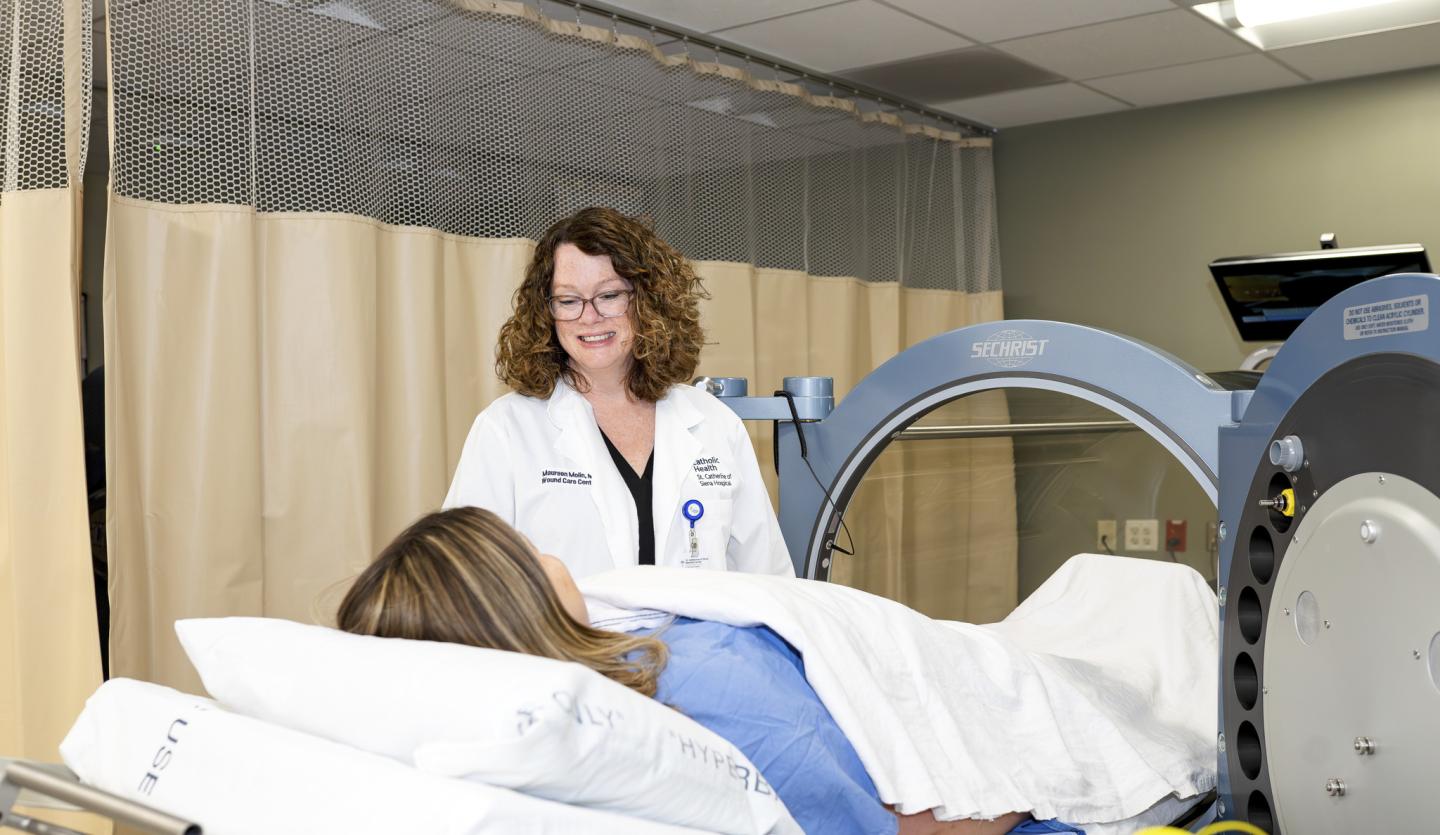
Most Catholic Health centers use a hyperbaric chamber built for one person. It is a clear acrylic tube with a padded bed. You lie down, the door closes and the technician slowly raises the pressure.
As pressure builds, your ears will feel full, like they do when a plane lands. Yawning or swallowing helps. The chamber may also feel warm at first. Once you reach full pressure, the fullness fades and you simply relax and breathe.
A typical session lasts about 90 minutes to two hours. Many people watch TV or a movie. Some fall asleep. A trained technician watches you the entire time, and you can talk with them whenever you need to. If you feel discomfort, they can adjust the pressure or stop the session.

The first session is always the hardest because it is new. Some patients are nervous about being in the chamber. By the third or fourth visit, most of them are bringing a favorite movie and chatting with our technicians. We go at your pace, and you are never alone in there.


 Edge
 Chrome
 Safari
 Firefox