

 Find a Doctor
 Find a Location
 Programs & Services
 Appointments & Video Visits
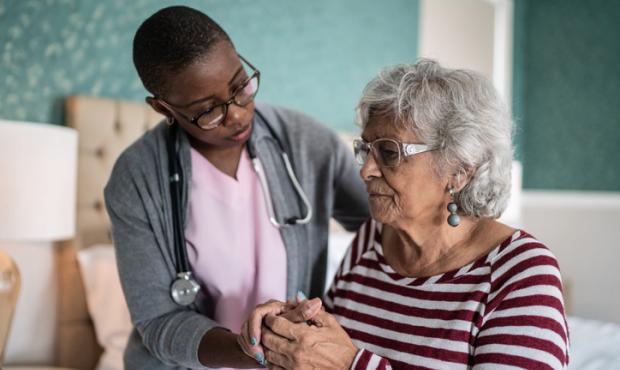
Catholic Health’s Alzheimer’s & Dementia Program is dedicated to supporting individuals and families facing memory loss with early detection, accurate diagnosis and compassionate, ongoing care. Our goal is to enhance quality of life and provide clarity and guidance at every stage of cognitive change for patients across Long Island.
Our team includes Neurologists, Neuropsychologists, Geriatric specialists, Psychiatrists and Social Workers who collaborate to deliver coordinated care. With access to multiple Catholic Health locations, patients can receive seamless evaluation and treatment close to home.
More Than Just Memory Loss: Understanding the Difference Between Alzheimer’s and Dementia
While the terms are often used interchangeably in casual conversation, dementia and Alzheimer’s are actually not the same thing. Learn More.
Our Approach

We offer a comprehensive evaluation process designed to identify the cause of memory changes and determine the most effective plan of care. Our diagnostic services include:
- Cognitive assessments such as MoCA, Mini-Cog, MMSE and GPCOG
- Neuropsychological evaluations administered across all CH regions
- Brain imaging (CT, MRI, PET, Amyvid)
- Psychiatric assessments to evaluate mood, behavior or emotional factors
- Bloodwork to identify reversible conditions affecting cognition
- CSF (spinal fluid) testing and genetic testing when appropriate
- Evaluation of functional abilities and daily-living skills
This multi-layered approach ensures that each patient receives an accurate diagnosis and a clear understanding of their current condition.
Alzheimer's & Dementia Program

I got lost on the expressway one day, and I just felt it was time.
My mother, then on my father's side, my three aunts were all very bad with dementia.
There's just so much sadness because that's not your mother anymore.
That's not your father anymore.
It's not your aunt anymore.
It weighs on your mind that what's it gonna be in five years if I don't get treatment?
I made my own appointment with a neurologist.
The diagnosis was, mild cognitive decline.
Come back in a year.
That just didn't satisfy me.
I went to my regular physician.
He said, "I think I have somebody who may be able to help you," and it was Dr. Bardia.
The basic pathology with Alzheimer's disease is there's amyloid plaques and neurofibrillary tangles that are formed in the brain cells.
This medication takes the amyloid plaques from the brain away.
If they get into moderate and severe stages, the medications do not really work.
The first time I came for the infusion, the next day there was just a remarkable difference in me, i- just from that one infusion.
My other half noticed it also.
He says to me, "You're different today."
I, I am just thrilled and thankful to my regular physician for recommending me to Dr. Bardia.
Her initial complaint was she forgot her way to her friend's house, and now she's able to go back and drive back to her friend's house without any difficulty.
She's also having difficulty with speaking, but with this medication, she's able to verbalize the thought that she has.
So I think that this medication has helped her.
So words are coming out, meaning you're able to think-
Think and say.
Yes.
Before, it wasn't.
Correct.
When the words were hard to find-
Mm-hmm it was discouraging to talk to somebody.
That better?
That does appear better, yes.
The early dementia program is an interdisciplinary program that involves my field, neuropsychology, neurology, as well as pharmacology and the infusion center, and our job is to really make sure that our patients get the best treatment possible.
These are newer treatments from a clinical perspective, and what they do is they allow us to have better control of helping patients have better quality of life because they really do minimize the progression over time.
The older medications would kinda serve as a Band-Aid, so these are a lot better in the sense that we can have more control over disease progress.
I have told so many people about this, and they're like, "We never knew that there was even a treatment out there."
I am just so personally relieved that there is a program that most people are completely unaware of.
To know for me personally there could be a light at the end of the tunnel, and like I told my children, I said, "I know if I don't go for this treatment, I know what my future will be, and I don't want it."
To me, this has just been a blessing.
I don't mind telling people that yes, I was diagnosed with this.
I'm just glad that we're addressing it.
Support for Families and Caregivers
Memory loss affects the entire family, not just the individual. We provide:
- Education on communication, daily care, and symptom management
- Resources for aging-in-place and long-term planning
- Help identifying caregiver stress and burnout
- Navigation support for accessing community programs
Through collaboration with the Alzheimer’s Association and the Long Island Alzheimer’s & Dementia Center (LIAD), families have access to support groups, early-stage social engagement programs and additional resources at no cost.


 Edge
 Chrome
 Safari
 Firefox